

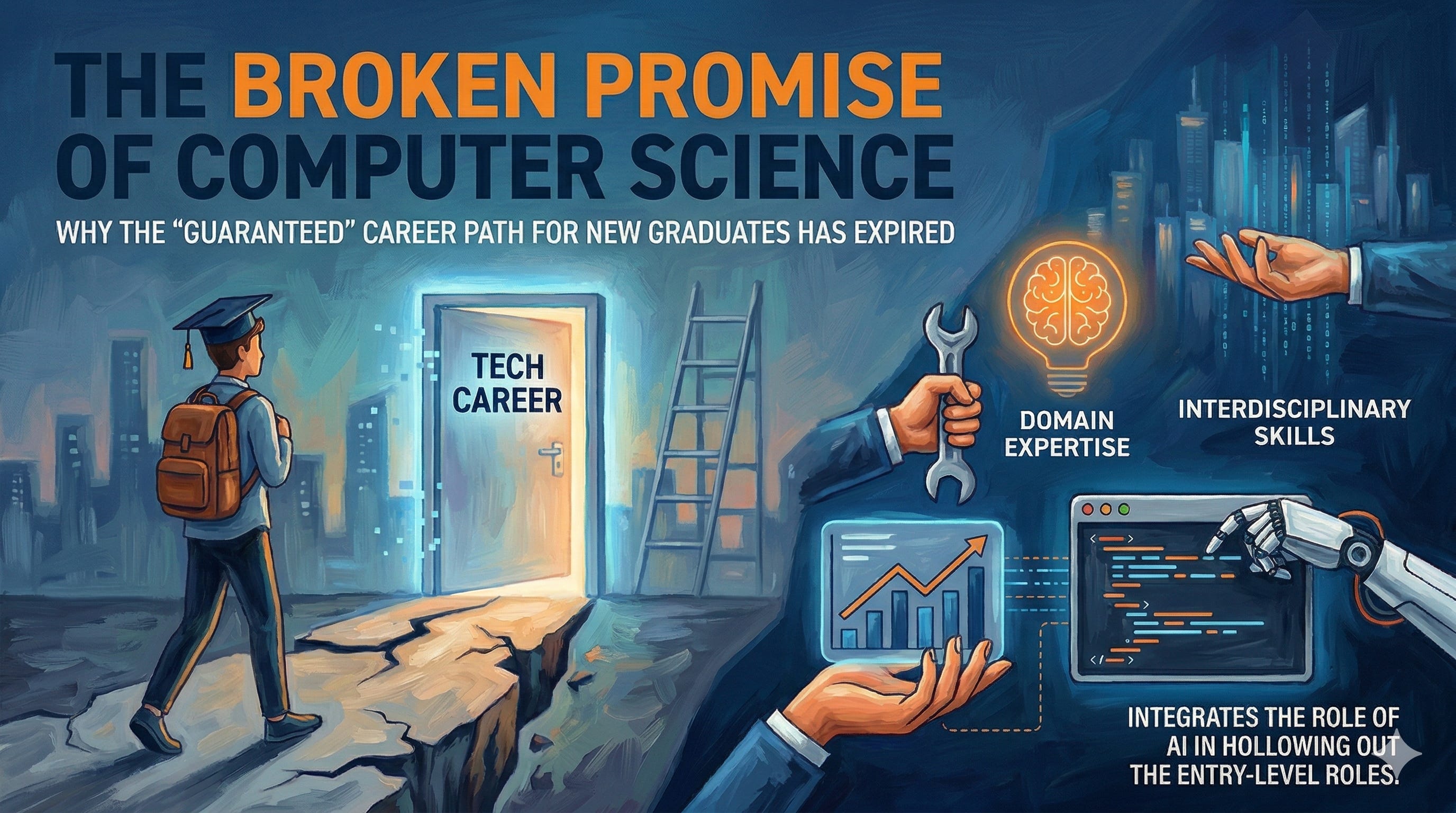
For the better part of two decades, the advice was practically unanimous. Guidance counselors said it. Parents said it. Reddit said it. The message was simple: study computer science, get a six-figure job, live happily ever after. It was the closest thing America had to a guaranteed career path.
That guarantee has expired.
The Numbers Nobody Wants to Talk About
Here’s the stat that should make every parent rethink their assumptions: the unemployment rate for recent computer science graduates has hit 6.1%. Computer engineering graduates? 7.5%. To put that in perspective, fine arts graduates -- the very people CS majors were told they’d never want to become -- are now more employed than computer engineers.
These aren’t anomalies. They’re data points from the Federal Reserve Bank of New York, and they paint a picture of an industry undergoing something more fundamental than a cyclical downturn.
The raw numbers are staggering. Over 127,000 workers at U.S.-based tech companies were laid off in 2025. So far in 2026, another 55,000+ have been cut. According to Indeed’s 2025 Tech Talent Report, tech job postings have dropped 36% compared to pre-2020 levels. And the roles that are disappearing fastest? Entry-level ones -- precisely the jobs that new graduates need.
Meanwhile, the supply side has gone in the opposite direction. U.S. universities handed out roughly 110,000 CS bachelor’s degrees in 2022-2023, about double the number from a decade earlier. We spent years telling every ambitious 18-year-old to study CS, and they listened. Now they’re all showing up to a party that’s winding down.
The AI Elephant in the Room
The factor that makes this different from previous tech downturns is artificial intelligence, and not in the way most people think. AI isn’t just creating new jobs in tech while eliminating old ones. It’s fundamentally compressing the value of the skill that CS graduates were trained to sell: writing code.
A Stanford Digital Economy Study found that by July 2025, employment for software developers aged 22 to 25 declined nearly 20% from its peak in late 2022. But here’s the twist: employment for developers aged 35 to 49 actually increased by 9%. The industry isn’t dying. It’s hollowing out from the bottom.
The reason is straightforward. AI coding tools have gotten good enough that a senior engineer with Claude Code or GitHub Copilot can do work that previously required a team of three or four juniors. One engineer at a large San Francisco tech company told the SF Standard that all of his code is now written by AI: “I’m basically a proxy to Claude Code.” Companies don’t need fewer software engineers total -- they need fewer beginning software engineers. And those are exactly the people we’ve been minting by the tens of thousands.
Even graduates from elite programs aren’t immune. Data from SignalFire shows that the share of graduates from MIT, Stanford, Carnegie Mellon, and UC Berkeley employed as engineers at major tech companies dropped from 25% in 2022 to just 11-12% recently -- a decline of more than 50%. If a Stanford CS degree can’t reliably get you into Big Tech anymore, what chance does a degree from a mid-tier state school have?
The individual stories are brutal. Manasi Mishra, a CS major from Purdue, received exactly one interview offer after a year of searching -- from Chipotle. Zach Taylor, an Oregon State graduate, submitted over 5,700 applications with no success. These aren’t lazy people or weak students. They did everything they were told to do. The system just changed the rules while they were playing the game.
The Enrollment Cliff Is Already Here
The market is starting to send signals back to prospective students, and they’re listening. For the first time since the early 2010s, total enrollment in traditional CS undergraduate programs has dropped by 6%. The University of California system is reporting noticeable declines in CS majors even as overall university enrollment rose by 2%.
This is a meaningful shift. For years, CS departments couldn’t build lecture halls fast enough. Now the tide is turning, not because students suddenly lost interest in technology, but because the career calculus no longer adds up the way it used to. When 55% of hiring managers expect more layoffs and 44% say AI will be the top driver, students and their families are paying attention.
So What Do You Actually Tell a Teenager?
This is where the conversation gets uncomfortable, because the honest answer isn’t as clean as “just major in CS” used to be. But here’s my best attempt at advice that accounts for the world as it actually is, not as it was five years ago.
First, stop thinking in terms of “safe” majors. The entire concept of a safe major is a relic of a more stable economy. The same forces that disrupted CS -- AI automation, globalization, rapid industry shifts -- are coming for every field eventually. The goal isn’t to find the one discipline that AI will never touch. The goal is to become the kind of person who can adapt when your field inevitably changes.
Second, domain expertise is the new moat. The graduates who will thrive in an AI-saturated economy aren’t the ones who can write the best code. They’re the ones who deeply understand a specific problem domain -- healthcare, energy, logistics, finance, education -- and can use AI tools to solve problems within it. A nursing student who understands AI-assisted diagnostics is more valuable than a CS graduate who can sort algorithms on a whiteboard. An environmental scientist who can build data pipelines for climate modeling has a career that no chatbot is going to replace.
Third, the trades and physical-world careers deserve a serious look. Electricians, plumbers, HVAC technicians, construction managers -- these are careers with strong demand, rising wages, no student debt, and near-zero risk of AI displacement. The largest areas of total job creation right now are in care, construction, logistics, and education. These roles combine people skills with hands-on work that simply cannot be automated away. The cultural bias against trade careers has always been irrational, and the current moment makes it look even more absurd.
Fourth, if a student genuinely loves CS, they should still study it -- but differently. The degree itself still has long-term value. NACE data showed CS topped the starting salary list at $88,907 for the Class of 2024. Software engineering roles overall are projected to grow by 17% through 2033. The Bureau of Labor Statistics projects 317,700 annual openings in computer and IT occupations through 2034. The field isn’t dead; it’s restructuring. But students need to graduate with more than a transcript. They need a portfolio of real projects, experience with AI tools, and ideally a secondary area of expertise. The formula has changed from “degree equals job” to “degree plus portfolio plus real experience equals job.” Students who treat their CS education as a foundation rather than a finish line will be fine. Students who expect the degree alone to open doors are in for a painful surprise.
Fifth, consider the interdisciplinary path. Pair a major in something you find genuinely interesting -- biology, political science, economics, design -- with a minor or certificate in data science, cybersecurity, or applied AI. This combination produces exactly the kind of hybrid thinker that employers are scrambling to find. The fastest-growing roles include AI and machine learning specialists, sustainability specialists, and business intelligence analysts. Notice how each of those combines technical skills with deep knowledge of a specific domain.
The Bigger Picture
What’s happening in computer science is a preview of what’s coming for many white-collar professions. Anthropic CEO Dario Amodei has warned that AI could eliminate half of all entry-level white-collar jobs within one to five years. Geoffrey Hinton, the so-called godfather of AI, predicts that in a few years, AI will be able to handle software engineering tasks that currently take a month. Whether those predictions are precisely right or somewhat exaggerated, the direction is clear.
The old playbook -- pick the “right” major, get the degree, collect the job offer -- is breaking down. The new playbook is messier and less reassuring, but it’s also more honest. It says: develop real skills, not just credentials. Combine disciplines rather than siloing into one. Stay curious about how AI is reshaping your field instead of ignoring it. Build things that demonstrate what you can do, not just what you studied. And for the love of everything, don’t pick a major solely because someone told you it was “safe.”
The safest bet in an era of rapid change isn’t picking the right field. It’s becoming the kind of person who can learn a new one.