

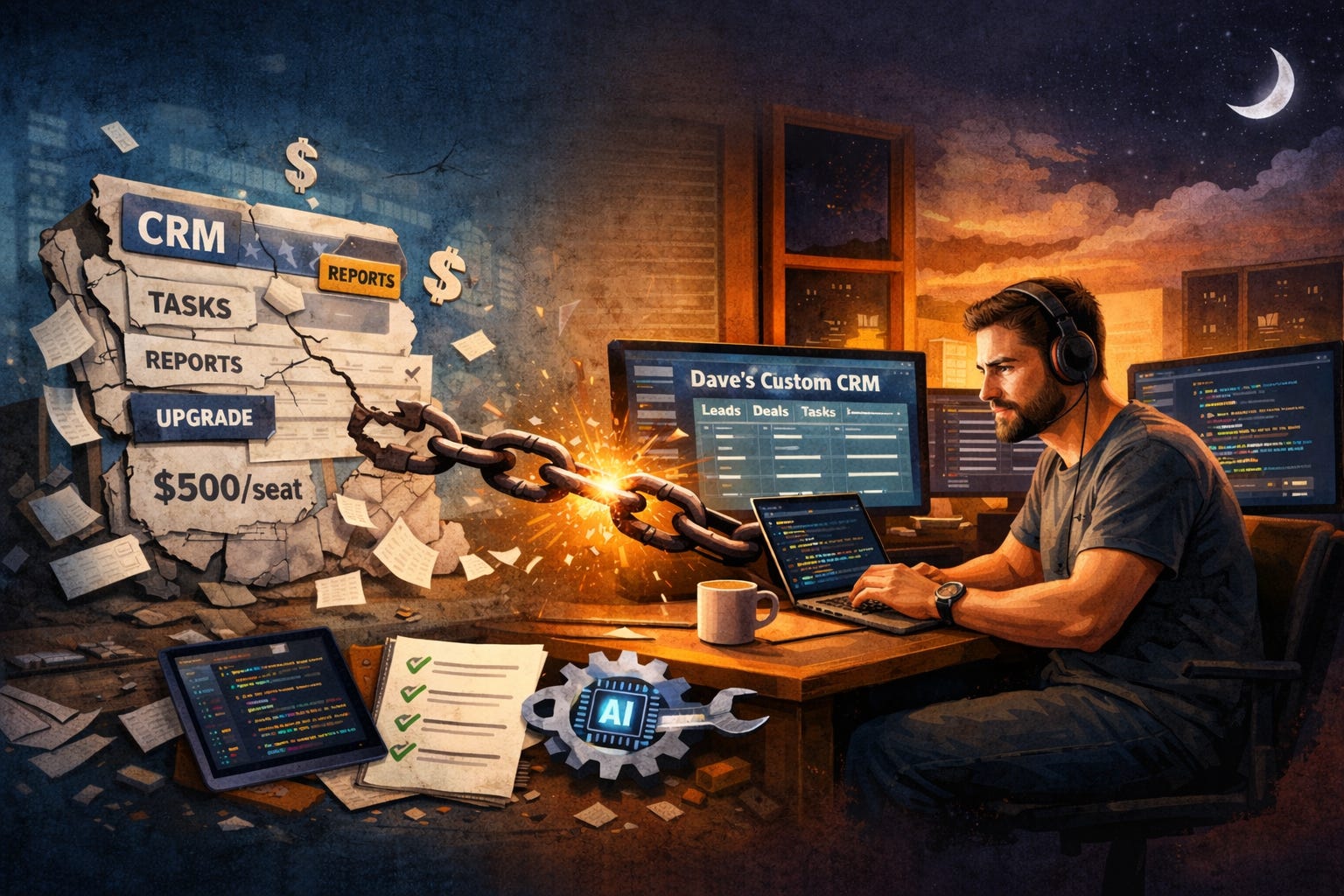
Dave Clark, the former CEO of Worldwide Consumer at Amazon, built a custom CRM in a night and a morning for his new startup.
Not a prototype. Not a demo. A real system that actually fits how his company sells.
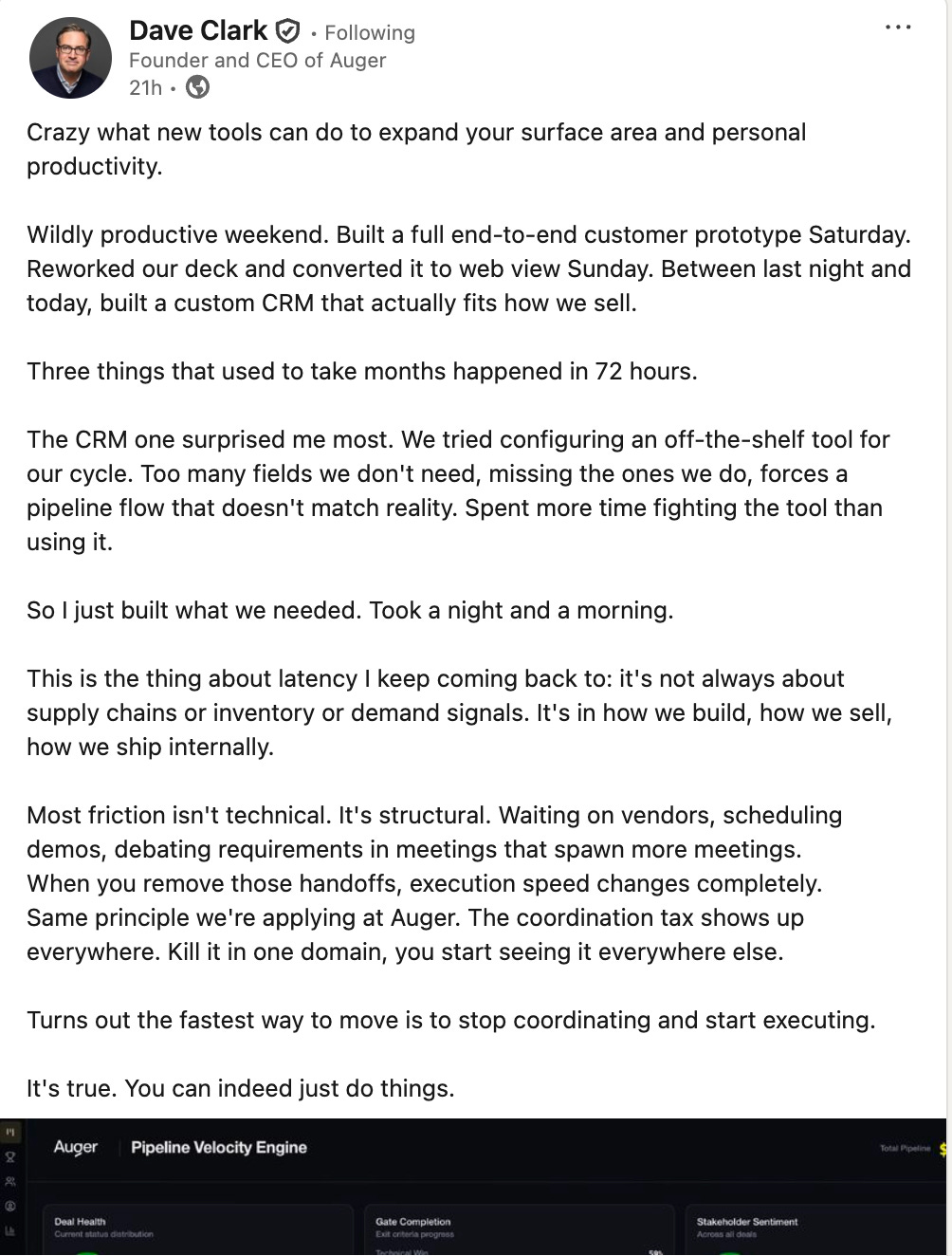
He tried the off-the-shelf option first. Too many fields he did not need. Missing the ones he did. A pipeline that did not match reality.
His verdict: “I spent more time fighting the tool than using it.”
So he stopped fighting it and built exactly what he needed.
That should scare every SaaS company charging $50 to $500 per seat per month.
The SaaS bargain is breaking
The SaaS model rests on a simple trade. It is cheaper to pay us every month than to build this yourself.
That math worked when “build it yourself” meant hiring engineers, provisioning infrastructure, coordinating teams, and maintaining software for years.
That math is collapsing.
Over the past year, I have saved my company tens of thousands of dollars in SaaS fees by doing exactly what Dave did. I replaced internal tools that used to justify six-figure annual contracts with custom software built in days.
Not because I suddenly became a better developer. Because development itself fundamentally changed.
The real product was coordination
SaaS companies did not really sell software. They sold relief from coordination pain.
You did not buy Salesforce for a database. You bought it to avoid months of requirements gathering, vendor evaluations, implementation plans, and training sessions.
Dave put it perfectly: “Most friction is not technical. It is structural. Waiting on vendors. Scheduling demos. Debating requirements in meetings that create more meetings.”
When AI removes that friction, what remains?
A monthly bill for features you do not use and workflows that do not match how you actually operate.
The bloat problem
Every successful SaaS product follows the same arc.
They start focused and useful. Then they chase enterprise checklists. Features get added to satisfy procurement, not users. Five years later, you are paying for 200 features to use 12.
Custom tools have the opposite profile. They do exactly what you need and nothing more.
That used to be a weakness.
Now it is the advantage.
The open source middle path
You do not even have to start from scratch.
Open source alternatives exist for nearly every SaaS category. CRMs, project management, analytics, help desks. The code is free. The problem was always implementation and customization.
That problem just got solved.
Take an open source CRM. Fork it. Strip out what you do not need. Add the fields that match your actual sales process. Deploy it on your own infrastructure. A year ago, that was a multi-month project requiring specialized talent. Now it is a weekend with AI assistance.
You get the foundation someone else built, customized exactly to your workflow, with no per-seat fees and no vendor lock-in.
The SaaS pitch was always “why build when you can buy?” Open source offered a counter: “why rent when you can own?” But ownership came with complexity that made the rental worthwhile for most companies.
AI collapses that complexity gap. The open source option just became viable for companies that never would have considered it.
Who is most at risk
Not all SaaS categories are equally exposed.
The most vulnerable: horizontal tools with generic workflows like CRMs, project management, and basic analytics. High per-seat pricing with low switching friction. Products where the interface is the value, not the data or the network. Tools where customers can export their data and rebuild the experience on their own stack.
If your customer is paying $50,000 a year and can recreate 80 percent of your product in a long weekend, you are not selling software. You are renting time until replacement.
Who survives
Some products still have real moats.
Network-driven tools where value increases with adoption. Deeply embedded systems where replacement touches everything. Highly regulated workflows where homegrown software creates compliance risk. Products where the proprietary model is the product, not the UI wrapped around it.
These companies are not competing with weekends.
Everyone else is.
The venture math problem
Most SaaS companies are still priced and operated on growth-era assumptions.
High acquisition spend justified by long-term retention. Valuations built on 95 percent net revenue retention. Switching costs assumed to be structural.
Those assumptions are eroding fast.
If a customer can rebuild your core functionality in 72 hours, your churn model is already wrong. And if you raised at a double-digit revenue multiple assuming it would never happen, no amount of “AI features” will save you.
The only thing holding this together
Right now, the SaaS industry is not being sustained by product value. It is being sustained by friction.
Switching costs. Multi-year contract lock-ins. The pain of migrating data. The institutional inertia of “we already use this.”
These are not moats. They are delays.
Every contract that expires is a decision point. Every renewal is now a question that did not used to get asked: do we actually need to keep paying for this, or could we just build it?
SaaS companies know this. It is why sales teams push so hard for multi-year commitments. It is why auto-renewal clauses exist. It is why cancellation flows are designed to be as painful as possible.
The product is no longer the lock-in. The contract is.
That works until it does not. And when enough companies start doing the math at renewal time, the churn will not be gradual. It will cascade.
What this means for buyers
Before you sign your next annual contract, ask one question:
Could we build 80 percent of this in a weekend?
If the answer is yes, you probably should.
The SaaS industry spent 15 years convincing companies that building software was too hard to attempt.
That was true.
It is becoming less true every month.
I am not renewing three contracts this quarter. The replacements took less time to build than the sales calls took to schedule.