

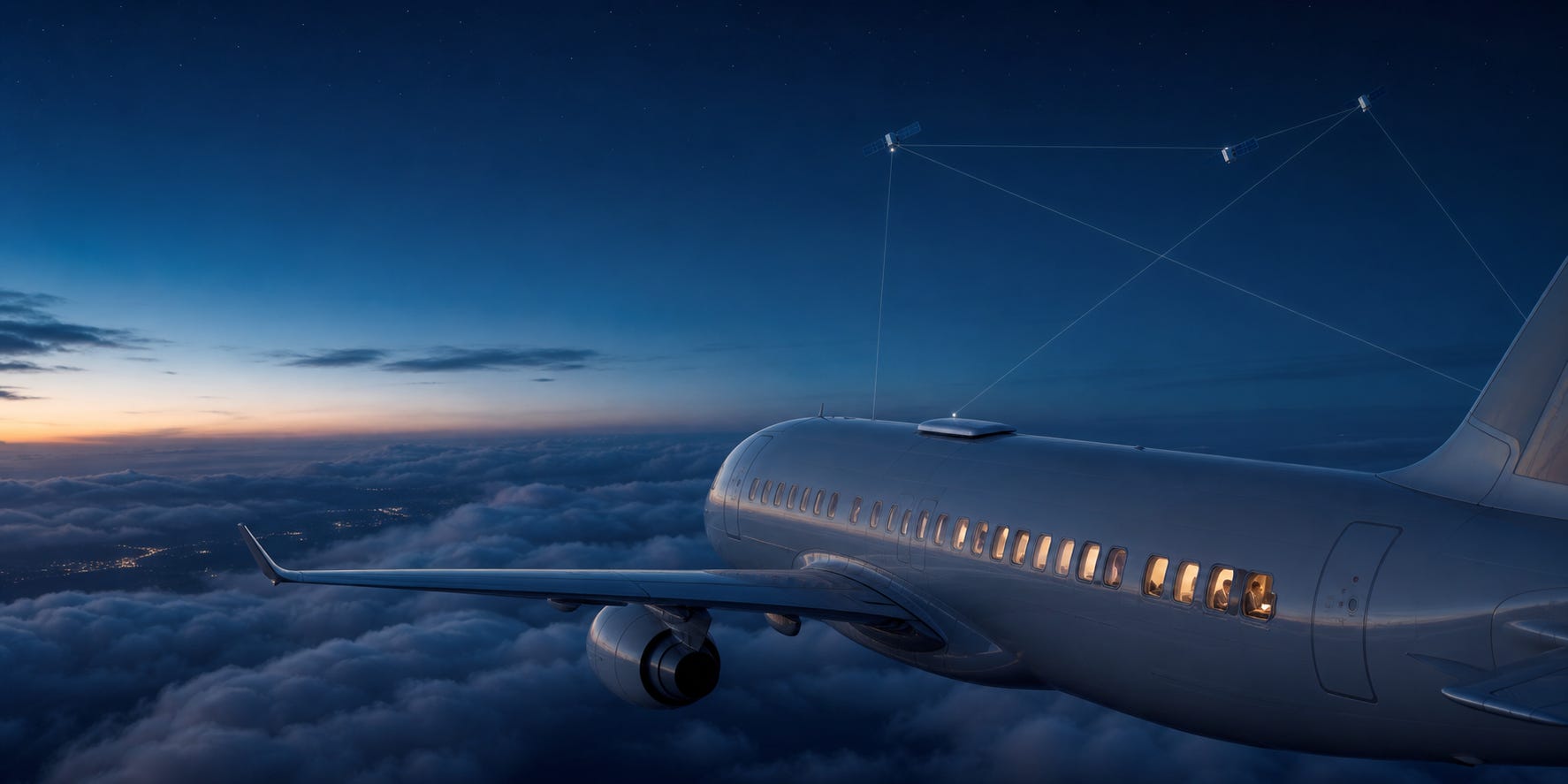
I flew Toronto to San Francisco this week. Five hours, gate to gate, on a United mainline aircraft with a Starlink antenna on the roof. I worked the entire way, on everything, with no allowance made for the fact that I was in the air, and I landed having had an ordinary working day that happened to take place at 38,000 feet.
It was the best flight I have ever taken.
I want to be honest about how low a bar that clears. The seat was a normal seat. Lunch was pretzels and water. The only thing different was the connection, and I want to be specific rather than saying it worked, because every airline on earth has claimed their Wi-Fi works for fifteen years. I had better than 50 Mbps down and better than 50 Mbps up, for five straight hours. Symmetrical, which is the part nobody mentions, because uploading is what you do when you are contributing rather than consuming. It was not a good version of airplane internet. It was indistinguishable from sitting at my desk in my own office.
I have flown that route, and the forty other versions of it I take in a year, on standard airline Wi-Fi: you buy the pass, get a connection that technically exists, and spend five hours discovering the list of things it cannot do. This time there was no list.
Which brings me to a bookmark that other people find odd and I find the most rational tab I keep. There is a website whose entire purpose is to count how many United aircraft have had a Starlink antenna bolted to the roof. It is called the United Starlink Tracker, and as of this week it reports 481 of 1,807 aircraft equipped, roughly 27% of the fleet, with more than 40 installs a month.
Here is the part that should embarrass the industry. That is the best information available, and it is not certainty. The aircraft is not firmly assigned until a few days before departure, so at the moment you buy the ticket the tracker gives you a probability and nothing more. United’s mainline fleet was about 12% equipped when I booked, so what it honestly told me was that I would probably lose. I drew a good tail, which is the only reason I have a story here and not a complaint. Five hours of my working life, on a route I fly constantly, and the best available instrument was a third-party website quoting me odds.
Let me state my willingness to pay plainly, because it matters later. I would pay $50 an hour for guaranteed high-speed connectivity, priced at checkout. On that Toronto flight that is $250 on top of the fare, for the same seat under a different antenna, and I would not think about it. Nobody is offering to sell me that, which is why nobody is collecting it. A free third-party database, maintained tail by tail because enough travelers want to know before they book, is a market pricing an amenity the sellers have not gotten around to pricing themselves.
We did, of course, once build a tracker for legroom. SeatGuru ran for almost 25 years as the place you went to find out whether 14C was a bulkhead or a lav-adjacent mistake, and it shut down on November 1, 2025, the same month United’s first Starlink-equipped mainline aircraft entered service. But notice the difference in kind. A seat map is reference data: you look it up once and the answer holds for years. A Starlink tracker is a progress bar, and people refresh it, because the underlying fact moves fast enough that a stale answer is actively misleading. The market builds infrastructure around whatever is both variable and decisive. Connectivity is no longer a feature of the cabin. It is the reason to pick the flight.
That would be a mildly interesting consumer observation if it were not also one of the more instructive capital allocation stories in aviation right now. The technology was available to everybody at roughly the same time, cost a rounding error against a fleet, and installs in a single overnight. What separated the winners from the losers was not money. It was the calendar.
The Airline That Went First Had 30-Seat Jets
The first airline in the world to sign a Starlink deal was not United, or Emirates, or Qatar. It was JSX, the public charter operator that flies out of private terminals and asks you to show up 20 minutes before departure.
JSX signed with SpaceX in April 2022, when Starlink’s aviation business essentially did not exist. Installation took two to three days per aircraft on 30-seat Embraer E135s, and the service was free from day one, no portal and no login. CEO Alex Wilcox’s framing of the whole business is the line worth stealing. The ultimate luxury is time.
So for roughly three years, a carrier with fewer than 60 small regional jets and coach-adjacent fares delivered a better working environment at altitude than nearly every flagship business class cabin on earth. A $12,000 lie-flat suite on a transatlantic 777 had worse internet than a $299 hop out of Burbank. The technology was equally available to both. That is not a technology story. That is a decision-speed story.
The Constraint Was Never Capital
United’s Starlink installations take about eight hours per aircraft. Eight hours. That fits inside a normal overnight maintenance window, which is why United can run 40 to 50 tails a month without meaningfully touching utilization.
United announced its deal on September 13, 2024. Testing started in early 2025, the FAA certified the first mainline aircraft that September, and passenger flights followed in October. United now expects around 1,000 aircraft equipped by the end of 2026 and the entire fleet, wide-bodies included, done before the end of 2027.
The fleet split is the tell on how a big carrier sequences this. United Express is better than half done, 342 of 669 aircraft. Mainline sits at 139 of 1,138. The regional fleet went first because regional jets are simpler, cycle through maintenance faster, and are where the product gap was most embarrassing.
None of this required an invention. It required somebody with authority to say yes eighteen months earlier than their competitors did.
Delta Optimized the Deal Instead of the Calendar
Delta, which flies about 900 mainline aircraft on Viasat, did not take the Starlink deal. It went with Amazon Leo, bundled into a broader arrangement including seat-back content and AWS. Installations begin in 2028, starting with 500 aircraft, on a constellation that is not yet delivering commercial in-flight service.
I want to be fair, because it is the kind of decision that looks perfectly defensible in the room. Amazon almost certainly offered better economics, bundling connectivity with cloud spend creates real synergies on a spreadsheet, and avoiding single-vendor dependence on SpaceX, a supplier with a habit of becoming a platform and then repricing, is legitimate strategy.
But run the timeline. United finishes in 2027. Delta starts in 2028. That is a multi-year window in which the two largest premium-focused US carriers offer categorically different products on the single amenity that customers demonstrably rank highest after price.
And they do rank it highest. Viasat’s own survey of 11,053 travelers across ten countries found free quality Wi-Fi to be the most influential booking factor other than price, at 22%, ahead of food and legroom. Twenty-nine percent said they would pay more for it. Those numbers come from Starlink’s competitor, which is what makes them useful.
Delta negotiated the better contract. United bought the better years. In a business where customers re-choose you every single booking, years are the scarcer asset.
The Gap Is Latency, and Latency Decides What Job You Can Do
It is worth being precise about what separates a good connected flight from a bad one. The industry keeps describing the gap in megabits, and megabits are the least interesting part of it.
Starlink runs at about 550 km. Geostationary satellites, which is what most legacy in-flight Wi-Fi uses, sit at 35,786 km. That is a round trip of roughly 143,000 km before your keystroke reaches a server, and no amount of engineering fixes it, because the constraint is the speed of light. LEO delivers 20 to 40 ms. GEO delivers 600 ms or more. Bandwidth splits the same way: 100 to 350 Mbps per aircraft against 5 to 25 Mbps, shared across everyone on board. And that shared number is the download. Upload on a legacy system is a fraction of it, which is why on old airline Wi-Fi you can watch a video and cannot be in one.
That is a difference in kind, not degree. At 600 ms a video call does not degrade, it fails. So does anything else that assumes a conversation: SSH, remote desktop, a VPN into your own network, a shared cursor in a doc, a database query. What survives is the asynchronous half of knowledge work. Email. Reading. Writing into a local file. All of which, and this is the part nobody says out loud, you could have done with the Wi-Fi turned off.
So the old product did not sell you productivity. It sold you the ability to do the portion of your job that never required connectivity in the first place, and charged you $19 for it. The new product sells you the other half: you take the call, you unblock the person waiting, you push the fix, you sit in the room.
That is exactly what Toronto to San Francisco was. Not a flight on which I got some work done, a sentence that has always meant I cleared an inbox. A flight on which nothing was deferred. This is not five hours of extra output added to a normal week. It is the removal of a five-hour hole from the middle of a working day, plus the pile that hole generates, plus the evening spent digging out of the pile. One flight erased maybe eight hours of downstream cost.
Now put a number on it. A partner billing at $500 to $1,500 an hour is looking at $2,500 to $7,500 of capacity per transcon that either exists or does not. If you are an operator, the right input is not your rate but the throughput of everyone waiting on you. Eight people blocked behind a decision only you can make do not lose your five hours, they lose forty. And the fare difference is usually zero. Same airline, same route, same fare bucket, different tail number.
I Would Rather Fly Commercial With Starlink Than Private Without
Private aviation is the most expensive way yet devised to move a human body, and it currently offers, on average, the worst connectivity per dollar in the sky.
Look at the installed base rather than the brochures. Gogo ended 2025 with 6,402 business aircraft online using air-to-ground service that tops out around 9.8 Mbps, priced at roughly $99 to $175 per hour of use. Its LEO product, Galileo, had about 120 aircraft flying as of March 2026, with a stated path to roughly 700 by year end. Even at the optimistic number, that is a tenth of the fleet.
Read that pricing again. Private aviation already sells connectivity by the hour, and already charges more per hour than the $50 I said I would pay, for a product roughly forty times slower. The hourly model is not exotic and the market plainly bears it. The only operators not using it are the ones whose product is finally worth paying for.
So the realistic comparison in 2026. Charter a midsize jet at $6,000 to $9,000 an hour and there is a solid chance you get 9.8 Mbps at 600 ms shared across the cabin, with the surcharge on top. Or board a United E175 in a 31-inch-pitch economy seat and get 250 Mbps at roughly 30 ms, free, gate to gate.
One of those is an office. The other is a very fast, very expensive waiting room with excellent snacks.
I am not making that trade hypothetically. Offer me a charter out of Toronto that morning in exchange for the connectivity I actually had and I decline on the way to the gate. The jet saves me two hours of airport. The antenna saved me the other five.
And this resolves the JSX story rather than contradicting it. Private aviation sells you time on the ground: no TSA line, no two-hour buffer, 20 minutes from curb to seat. Starlink sells you time in the air. Two halves of the same product, and almost nobody bought both. JSX did, in 2022, which is why a $200 seat on a 30-year-old Embraer out of a private terminal is, for a certain kind of working traveler, quietly the best value proposition in American aviation. Not because any part of it is luxurious. Because no part of it wastes the day.
Everyone Is Making the Same Pricing Mistake
The second allocation error in this story is one basically the whole industry is committing together: nobody is charging for it.
Remember the $50 an hour. On a five-hour flight that is $250 no airline is collecting, from a customer who volunteered the number, on inventory they already own. And it is worse than not charging, because they are also not selling. An airline mid-rollout has two kinds of seat worth materially different amounts to the same customer, prices them identically, and declines to say which one you are buying. Any carrier could fix this tomorrow by fencing off a subset of equipped tails, committing them to specific rotations, and selling the commitment. Nobody has. The most valuable attribute of the product is distributed by lottery, and a hobbyist website is doing the airline’s disclosure for it.
Every airline currently flying Starlink offers it free. Some gate it behind loyalty enrollment (United, Alaska and Air France all require a program signup) and the rest, JSX and Hawaiian and Qatar and Emirates among them, hand it to everyone. The gated version is defensible: you are converting a capital expenditure into program enrollments with measurable lifetime value, and the friction of a signup is trivial next to the friction of a paywall. Fine.
What nobody seems to be modeling is that this is a one-way door. Airlines spent twenty years training passengers that in-flight Wi-Fi is a paid product, then about eighteen months retraining them that it is free. You do not get to reverse that a third time. Checked bags went from free to paid and the industry absorbed the outrage exactly once. Going from free back to paid, on the amenity customers say matters most, on aircraft where a competitor is giving it away, is not a fight anyone will pick.
So the entire industry is permanently pricing its most valuable differentiator at zero, right at the moment it is most differentiated. The window to sell guaranteed connectivity at a premium is open right now and closing. My read is that it shuts around the time the third major US carrier finishes its rollout, after which connectivity stops being a product and becomes an expense line, permanently.
The Advantage Window Is About Three Years Wide
Count the rollouts. Hawaiian, JSX and Zipair are done. Qatar, Emirates, Air France, WestJet and British Airways are mid-installation, finishing between now and 2028. American and Singapore start in early 2027. Lufthansa Group is working through roughly 850 aircraft by 2029.
By 2029, satellite connectivity on a major carrier will be as noteworthy as a seat-back pocket. Which means the entire strategic value of this technology is concentrated in a window that opened in 2025 and closes around 2028, and your position in that window was determined by a procurement decision you made in 2022, 2023 or 2024.
Somebody Is Going to Sell the Working Seat
What I am buying on a six-hour flight is not the seat, it is the six hours. A lie-flat suite with 600 ms of latency is a very expensive nap. A middle seat where my entire toolchain works is a branch office at 39,000 feet.
Wilcox was right that the ultimate luxury is time. The carriers that installed early bought the air half of it by accident, and mostly have not noticed what they are sitting on.
So somebody is going to sell the working seat. The first thing it sells is not an antenna, it is a promise: this flight, this booking, guaranteed equipped, and if we swap the aircraft you are compensated. Then reserved bandwidth, power, and no middle seat. Price it by the hour, the way private aviation already does, and aim it at the travel manager who cannot justify a $4,000 business class fare but can very easily justify six recovered working hours at a fully loaded cost of several hundred dollars each. Whoever builds it first converts an antenna into yield instead of into goodwill.
Until then, we are all just refreshing a tracker to find out whether tomorrow’s plane is the good one.