

William Nordhaus died on October 30 at 85. Most of the obituaries led with climate: the Nobel, the carbon models, the decades of policy fights. Fair enough. That was the work that changed governments.
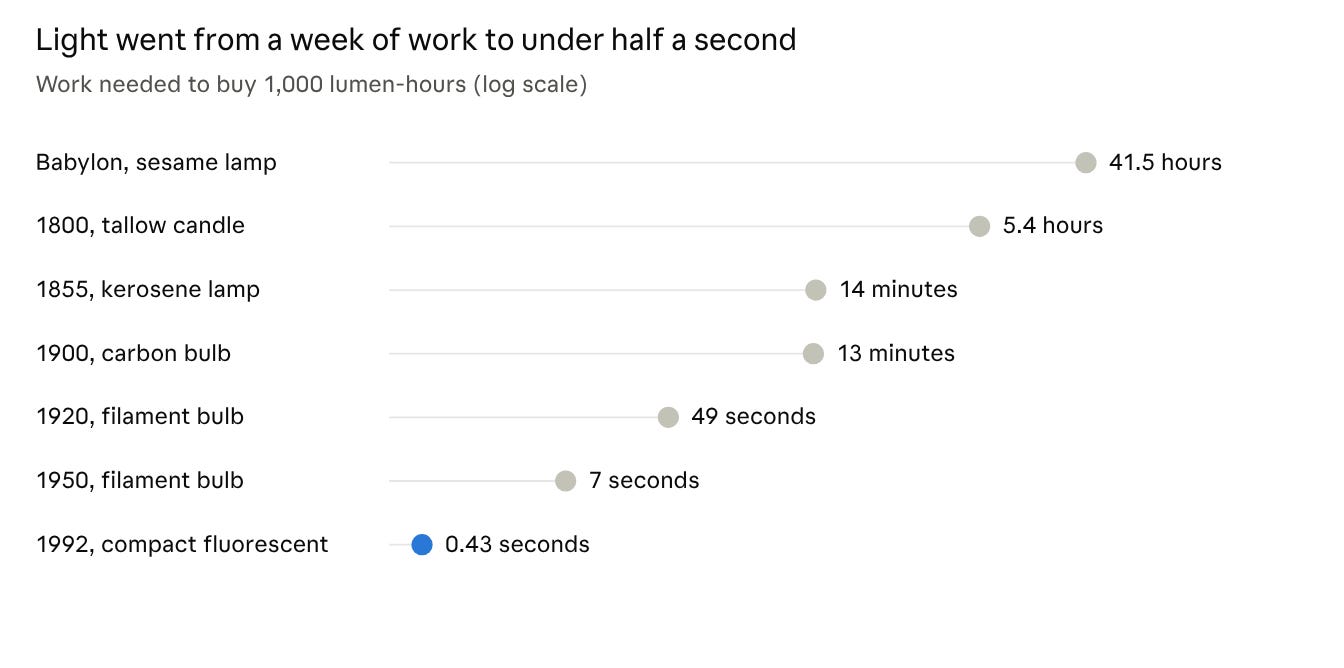
But the work that changed how I think was smaller and stranger. Nordhaus once set up a primitive oil lamp in his dining room, pointed a light meter at it, and wrote down what he saw. He wanted to know a simple thing: how many hours of human work did it take to buy light?
The answer is one of the best charts in economics.
A day's work for ten minutes of light
In ancient Babylon, a full day of labor bought enough lamp oil to light a room the way a modern bulb does for about ten minutes. Not ten hours. Ten minutes.
For thousands of years, that barely moved. Better wicks, better fats, beeswax, whale oil. By 1800, a full day's work bought about an hour and a half of that same light. Progress, technically. Not the kind anyone would notice in a lifetime.
It's hard to picture now how much that shaped a life. In Babylon, lamp oil burned in temples and was too expensive to use at home. In Norman England a bell rang at eight and you covered your fire for the night. That's where we get the word curfew, from the old French for "cover fire." For centuries poor families in Britain dipped rushes in bacon grease and got ten or fifteen minutes of light from each one. For most people, when the sun went down, the day was over.
Then it broke open. Town gas. Kerosene, which in Nordhaus's own words lit the world and saved the whales. Then electricity. By 1992, a thousand lumen-hours of light cost about 0.00012 hours of labor. Under half a second of work.
The work that bought a Babylonian an hour of light now buys about forty years of it. Light went from a luxury you rationed to something you don't even think about. You leave it on when you walk out of the room.
That is what free looks like. Not a price tag of zero. A price so low it falls out of your decision making entirely.
The part the economists missed
Nordhaus's real point wasn't about lamps. It was about measurement.
Our price indexes tracked what a candle cost, then what a bulb cost. They never captured that the thing itself had changed so much that the comparison was meaningless. So official numbers badly understated how much richer people actually got. The gains were real. The spreadsheets just couldn't see them.
I think about that a lot right now, because I'm watching it happen again.
Development just became light
In 2011, Marc Andreessen wrote that software is eating the world. He was right. Software companies moved into one industry after another, and the rest of us became their customers. But his argument had a quiet assumption in it: building software was hard, so a few companies would do it and everyone else would rent.
I started my development agency, Netalico, that same year. For most of the time since, software development behaved like Babylonian lamp oil. Expensive, scarce, rationed. Every feature was a negotiation. Every client conversation started with what can we afford to build and ended with a backlog that never got shorter.
That's over.
In the last two years, the cost of turning an idea into working code has collapsed the way the cost of light did. Not to zero. But to a price that's starting to fall out of the decision. A prototype that used to be a two week sprint is an afternoon. An internal tool nobody would ever have funded just... exists now, because someone wanted it before lunch.
And just like with light, the official numbers aren't going to capture it. Development agency revenue might even look flat while the amount of software getting built goes vertical. If you're measuring the candle, you'll miss the city.
What happens when something becomes free
Here's what history says, and it's the part I care about as an investor.
1. The value doesn't disappear. It moves. Some people got very rich selling cheap light. The bigger fortunes went to what cheap light made possible: factories running night shifts, cities that stayed open after dark, reading, retail, entertainment. The light was the input. The world built on top of it was the prize.
2. The bottleneck shifts to whatever is still scarce. When light was expensive, the question was can I afford to see? When it got cheap, the question became what's worth looking at? Same with code. When development was expensive, the constraint was engineering hours. Now the constraint is judgment: knowing what to build, for whom, and why it matters. Taste, distribution, trust, and the customer relationship are the new lamp oil.
You can already see it in the numbers. Apple's App Store added about 560,000 new apps in the first half of 2026, nearly as many as in all of 2025. Downloads over the same six months grew 2%. Building got cheap. Getting chosen didn't.
The people selling the old scarcity get squeezed, and in software it isn't happening evenly. Few companies start by rebuilding a big system of record. Those are protected by shared data, audits and trust, and no amount of fast coding shortens an audit. What goes first is the glue: the workflow automations, admin panels, dashboards and form builders that were always a nice interface on a simple job. In a survey by Retool, which sells tools for building your own, about a third of the builders and customers it polled had already swapped at least one SaaS tool for something they built themselves. So don't start with Salesforce. Start with the glue. And if the glue is what you sell, you're the candle maker.
Then the email came
I got to test this myself a few weeks ago. An email landed from Harvest, the time tracking tool my agency has run on for years. At our next renewal, our account was being moved to a new enterprise plan with usage billing. By my math, our price was going up about 500%.
Five years ago that email had one possible ending. I'd complain, maybe post about it, and then pay. Switching meant months of evaluation and migration, and building our own was a fantasy. That's the math any increase this size depends on.
This time I did post about it. We'd been logging time in our own dashboard since April. The hard part was invoicing, so we scoped four weeks to build that and cut over. As I write this, that sprint is almost done. Our own time tracking, built around how we actually work, for less in cash than a year of the increase, not counting our own hours.
The comments on that post taught me more than the email did. Bending Spoons agreed to buy Harvest last year, and it turns out we got off lightly. Other customers have reported renewals up 1,500% or more.
One commenter put it better than I could: they aren't pricing the timer anymore. The increase is a tax on how painful it is to move years of client and invoice history. That's exactly right, and it's exactly the tax that just got cheaper to dodge.
There was a fair counterpoint too. For big enterprises, time tracking is a compliance tool, and something built in a few weeks won't pass their audits. True. That's the core holding while the edges fall away. But a fifteen person agency is not that customer, and there are a lot more of us.
And I employ developers. If you don't, you need someone who'll look after what gets built, whether that's one capable person on staff or a partner on a support agreement. Without that, keep paying the bill.
That's the part SaaS companies should lose sleep over. It isn't that customers will rebuild everything. It's that every renewal email now gets read by someone who knows there might be an alternative they could build. Pricing power in software was always a bet that building was too expensive to consider. That bet just got a lot worse.
What we've replaced, and what we haven't
Harvest isn't our first. Over the past fifteen months, most of it since April, we've quietly rebuilt a good part of how the agency runs.
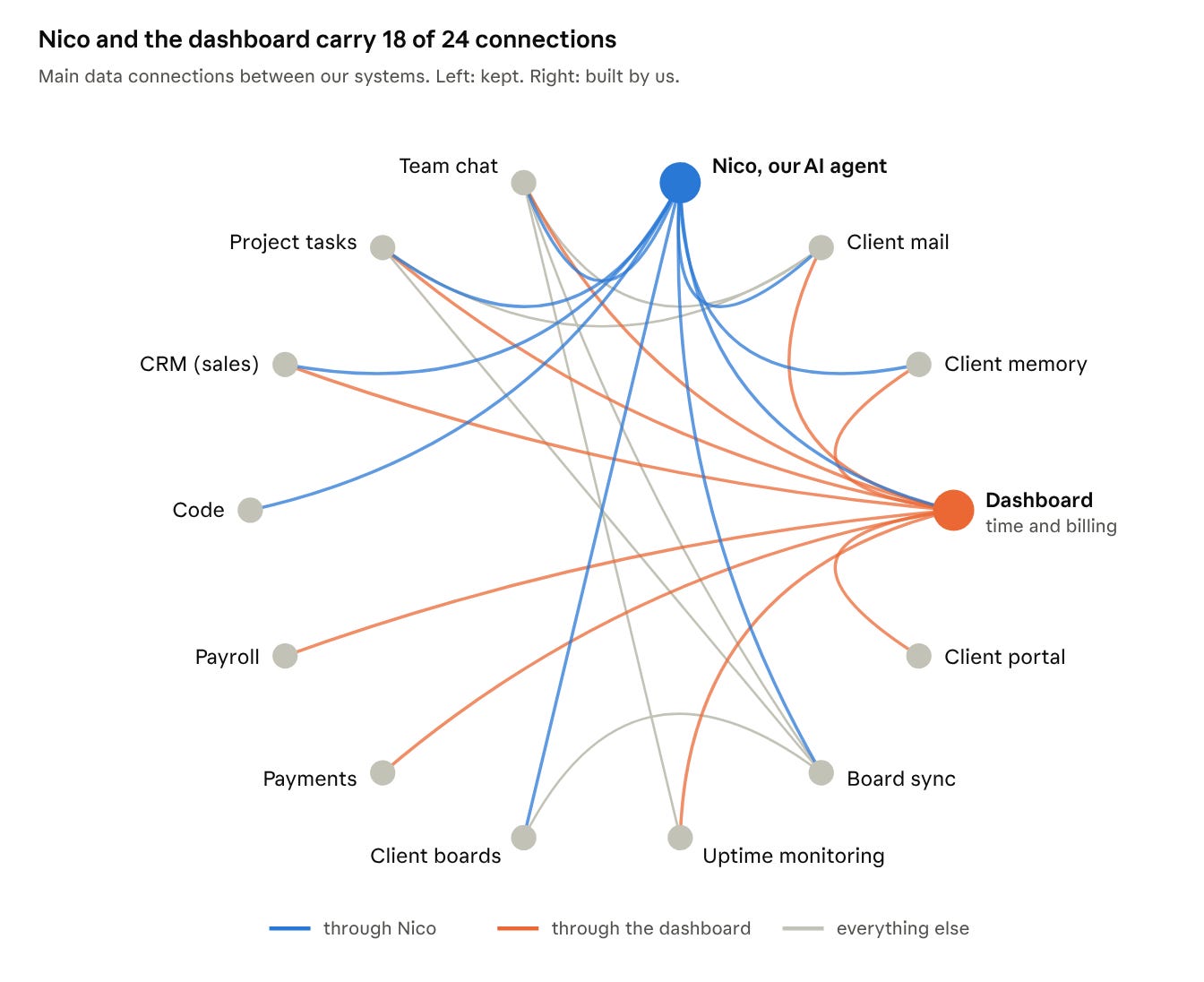
Replaced. Our shared client inbox used to live in a help desk product that was slow and had search nobody trusted. We looked at the usual alternatives, then built our own mail tool around the way we actually assign and follow client threads. Our client portal, where QA items and launch checklists live during a build, is ours too. Time tracking is nearly done.
Replaced by accident. Here's the one I didn't see coming. We still pay for a CRM, and the sales pipeline lives there. But once a deal is signed, the relationship now runs through tools we built: who the client is, who on my team owns them, every conversation, what's still owed. We never held a meeting and decided to move that. We built a small tool to fix an annoying inbox, kept adding the things we needed, and one day half of the CRM's job had moved, because the new tool sits where the conversations actually happen.
I think that's how the big systems get replaced. Not in a rip and replace project that a CFO would never approve (unless the app raises its price by 1,000%). One useful little tool at a time, each one cheap enough that nobody has to ask permission, until the system of record is something you built without noticing.
Augmented. Most of the gain hasn't come from replacing anything. It's come from wrapping AI around tools we kept. Our project management, chat and payroll are all still off the shelf, but now they talk to each other. A people cost dashboard that pulls payroll, contractor payments and tracked hours into one view used to be a spreadsheet someone dreaded every month. A shared memory of every client's history means a new team member can get caught up in minutes instead of weeks. None of those were products we could buy, because they only make sense for us.
The piece people notice is Nico, our internal AI agent. It sorts new sales inquiries, sets up onboarding tasks when a deal closes, nudges people about unlogged time, and can open a code change for a developer to review. Most of what a client would see waits for a person to say go.
Kept. We did not rebuild payroll. We did not rebuild project management or team chat. Those vendors carry real risk and real complexity, and they've earned their fee.
Tried and dropped. We started on a self-hosted replacement for Loom, then did the math: it would have saved somewhere between 3% and 30%, before the upkeep. We shelved it. Being able to build something isn't a reason to.
What it really saves. If we'd stayed with Harvest through the price increase and kept the other three tools, we'd be paying more than twice what our own tools cost to run. Counting Claude, hosting and pay-as-you-go AI, what we built runs for about 60% less. That doesn't count our own hours. The hosting is nominal. The work isn't. What we bought was software that fits, and the ability to say no to a renewal.
We're a company that just built a time tracker, and we mostly hadn't logged those hours, so I used the code history instead: about 43 hours of committed work in the Harvest sprint and 405 across our six main tools since April, agents included. At $100 to $150 an hour, Harvest earns itself back in roughly five to seven months, and the whole collection takes four to six years on subscription savings alone. One avoided price increase paid off quickly, and the rest has to earn its keep by making us better at the work.
I can see it from my own backyard
I live in the Shopify ecosystem, where this is playing out in public. Building an app used to be the hard part, so the app was the moat. Now one tracker counts about 30,000 apps in the store, more than double a year ago. Meanwhile Shopify's own assistant builds custom apps from a sentence. Merchants made about 12,000 of them in the first quarter of this year and 36,000 in the second. We don't know how many replaced a subscription, but those are 36,000 problems people solved without going shopping.
So the single-feature app is getting squeezed from both sides. The ones that hold up own data, carry real risk like payments or tax or fraud, or have a brand merchants already trust.
For merchants this is great news. For agencies like mine it changes the job. Clients used to pay us to stitch fifteen apps together. Now the valuable work is knowing which five to keep, which ten to replace with something we build and agree to support, and what the store actually needs to sell more.
We're writing more custom code for clients too, for jobs nobody would have scoped a few years ago. One client has more than 60,000 products that needed better labels. In October a script we wrote filled in one of those fields on nearly 64,000 of them. For the labels that take judgment, like subject, color and style, we built a tool that has AI look at each product. We tested five models against an answer key of 200 products that people had labeled by hand. We're starting with a first pass, and the client is now asking what the rest of the catalog would take.
Think about what that job used to be. Labeling 60,000 products by hand, at just one minute each, is a thousand hours. At a few minutes each, which is closer to what careful work takes, it's several thousand. Building custom software to do it would have been its own big project. So nobody would have compared the options. They just wouldn't have done it, period, and the catalog would have stayed the way it was.
That's the part the savings math misses. We're not only doing the old work cheaper. We're doing work that wasn't feasible at all, the way nobody in 1800 was lighting a stadium at any price. The biggest change isn't the bill that shrank. It's the project that never would have made it onto the list.
The code and the AI bill were the small part. The real work was agreeing on what right looks like. On the few products where two of the client's own experts had both picked a main color, they agreed on four out of seven. That's the new lamp oil again. Labeling got cheap. Deciding what the labels mean didn't.
I said something similar in an article Shopify published in June about using AI to move stores from one platform to another: "The strategy is still the hardest and most important part. AI doesn't change that. If anything it raises the stakes, because now you can execute a bad decision much faster." I believe it more now than I did then. When building was slow, a bad idea usually ran out of budget before it did any harm. Now it ships by Friday.
The build or buy equation changed
For most of my career, this was an easy call. A custom Shopify app, one built for a single store and never listed in the App Store, was a real project. You scoped it, paid for it up front and kept paying to maintain it. The app in the store was ready today for a small monthly fee. Unless you were big or strange, you rented.
That math had one giant number in it, the cost to build, and everything else was too small to matter. Now the giant number has shrunk, and you can finally see the rest of the equation.
Rent never ends, and it often rises as you grow. You pay for fifty features to use three. You bend your process to fit the app, then buy a second app to patch what the first one won't do. Your data sits in someone else's account. And as we learned from Harvest, somebody else can change the price.
A custom app does the three things you need, the way you work, and you own it. But it has a cost the old math hid too: you're now the vendor. Somebody has to update it when Shopify changes its platform, fix it on Black Friday and still understand it in two years.
So the question moved. It used to be can we afford to build this? Now it's do we want to own this?
Rent it when:
Being wrong is expensive: payments, tax, fraud, compliance
It gets better with data from thousands of stores
It has to keep up with outside rules or carriers
Nobody on your side will own it
Build it when:
It does one job, with rules only you have
You use a sliver of what you pay for
It's glue between systems you already own
Someone is named to look after it
The same test works for any SaaS product, not just Shopify apps. Payroll is a rent for us. Time tracking turned into a build.
The last release
When I started, software came out. There was a date, a number and sometimes a box. From 1995 to 2015, a new Windows arrived every two to five years. Then the web made it weekly, then daily, but we kept the word. A release was still a thing somebody finished and handed over.
I think that word is about to stop meaning anything.
Look at what happened inside Anthropic this year. In May it was merging about 2,500 code changes a day. By September it was more than 30,000, most of the code written by its own AI. Git, the tool nearly every programmer on earth uses to track changes, couldn't keep up. So seven people and Claude spent five months building a replacement for their own codebase. They say it isn't meant for the rest of us. But read what they changed along the way. On the team that built it, reviewers stopped reading every line and started examining the intent. The queue where changes wait their turn stopped making sense. Conflicts get fixed after the fact, because Claude can usually repair them faster than a person can find them. The engineers' job, they wrote, was to tell Claude "no."
You don't have to be Anthropic to feel it. Our three main internal tools shipped to production 140 times in the first 23 days of this month. There was no release day. Something got better, and it was live.
From finished thing to standing permission
So what's left of a release when the code never holds still? I think it becomes a decision. You stop approving the change and start approving the range of changes you'd accept: what this software must always do, what it must never do, and who gets to say no. Inside those lines it can be rewritten every hour. Outside them, it stops and asks.
One place this is already written down isn't Silicon Valley. It's the FDA, which lets makers of AI medical devices get a plan for future changes approved in advance, so each update inside the plan doesn't need a new submission. That's a release as a permission instead of a product. I expect contracts, audits and client approvals to end up looking a lot more like it.
It also means no two of us will be running the same thing. Your copy will change around how you work, mine around how I do. Version 4.2 made sense when everyone had version 4.2.
Agent source
That breaks open source too, or at least the way we share it. Open source gave you the code. You installed the package, waited for updates and sent your fixes back. But if an agent can write the code, the code isn't the valuable part anymore. What's valuable is everything that tells the agent what right looks like.
Call it agent source. Instead of sharing the program, you share what it takes to grow one: the intent, the rules, the tests, and the mistakes you already made so nobody else has to. Your agent grows a version that fits your business. When you find a bug, you don't send back a patch. You send back a test that fails, and everyone else's agent learns from it overnight.
The early signs are small and a little strange. One developer published a software library with no code in it, just a specification, 125 tests and instructions for your agent. Another project asks for prompt requests instead of pull requests. It reminds me of the BASIC programs people used to type in from the back of computer magazines. You got the recipe, you made it yourself, and then you changed it.
New cores
The more the surface varies, the more the center has to hold. If everyone's software is different, we'll need a smaller set of things that are the same for all of us: how money moves, how identity works, how permissions are checked, how a record stays true. I'd call those the new cores. They'll change slowly, be tested obsessively, and be trusted because of what they've passed, not who wrote them. Everything above them will be grown.
What could go wrong
Plenty. Google's research on software teams finds AI raises how much they ship while stability still falls. When one security firm scanned almost 4,000 shared agent skills, about one in eight had a critical flaw. Agents still reach for the popular tools they already know, which makes it hard for a new core to break in. And people get tired. Nobody wants to open their own software on a Monday and have to learn it again.
So the craft moves. It used to be writing the thing. Then it was shipping the thing. Next it's deciding what the thing is allowed to become.
That's where the light comes back in. Nobody announces a new version of the light in your kitchen. The power plant changes, the grid gets rerouted, the bulb gets swapped for a better one. You flip the switch and it's on. What stays fixed is the socket and the safety code. Software is headed there: always changing behind the wall, and trusted because of the few things that don't.
How I'm thinking about it
Here's the shift for operators and investors right now. If you run a development agency, stop selling the cost of building. That fight is over, and the cost won. Ask the Nordhaus question instead: if this input is now essentially free, what gets built on top of it, and who owns that?
Light became free, and the world rebuilt itself around it. Writing code is heading the same way. Owning it, securing it and keeping it running are not.
Software ate the world by being hard to make. Now that it isn't, the world gets to eat back.
Sources: Nordhaus's 1996 study on the history of lighting (NBER; Cowles Foundation Discussion Paper 1078, 1994), NPR Planet Money "The History of Light," Our World in Data, Yale News (October 31, 2026) and Albuquerque Journal (November 17, 2026) obituaries.
App Store figures: Sensor Tower via The New York Times. Build vs. buy survey: Retool, 2026.
Shopify figures: Shopify Q2 2026 earnings slides, via Investing.com for Sidekick apps; App Navigator, November 22, 2026 for App Store size.