

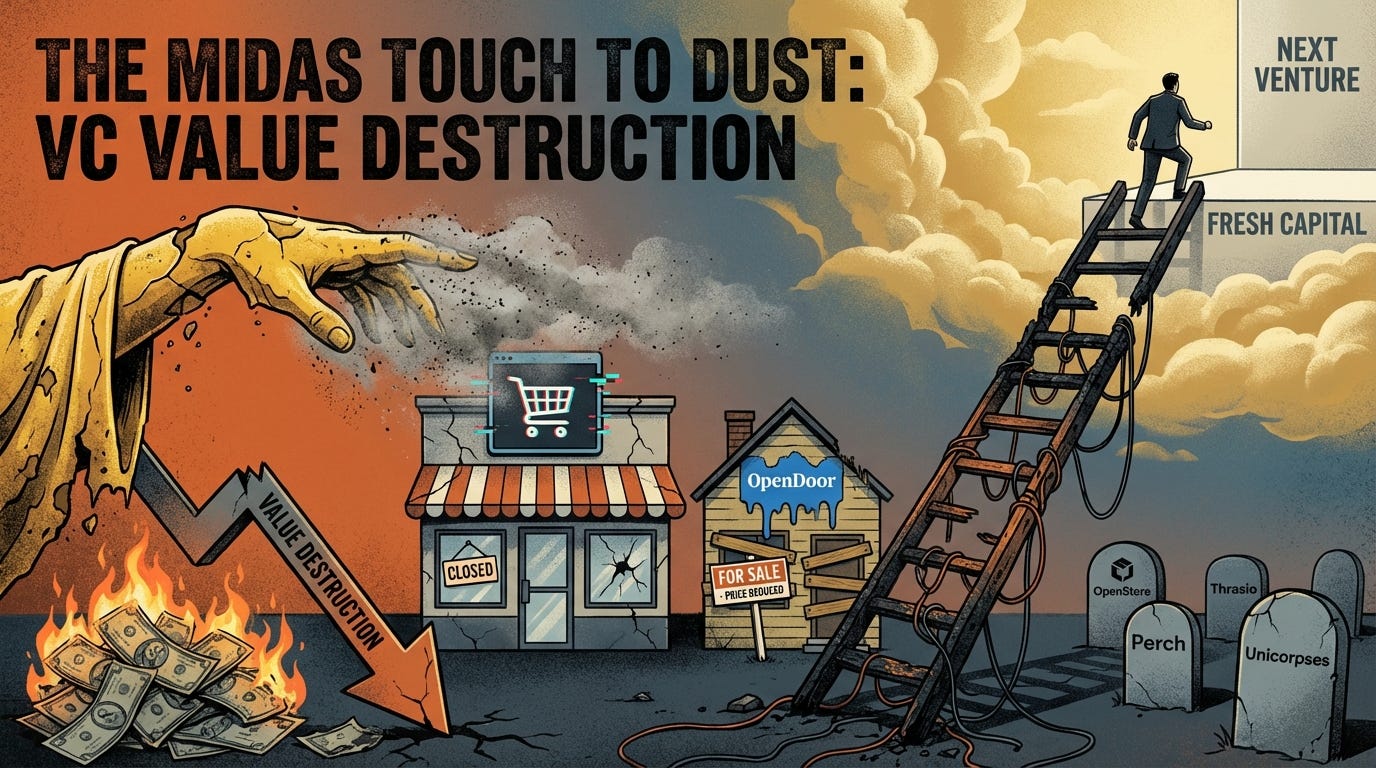
In June 2023, I publicly raised concerns about OpenStore. Not because I’m some oracle of business wisdom, but because the fundamentals were screaming red flags that anyone in the ecommerce space could see. The aggressive aggregation model, the lack of domain expertise, the hubris of believing algorithms could replace operational know-how.
I felt like Michael Burry in 2006, watching the mortgage market and wondering if I was the only one who could do basic math. The difference? Burry was betting against fraud hidden in complexity. I was just pointing out incompetence hiding in plain sight.
Now, in late 2025, OpenStore is essentially dead. They’ve shut down 40+ brands, keeping only Jack Archer, and reportedly raised at a $50 million valuation. That’s a staggering 95% drop from their previous nearly $1b valuation in September 2022. They raised over $150 million in investor capital buying brands they couldn’t profitably operate, all while their architect, Keith Rabois, promoted mediocre milestones on social media like they were revolutionary achievements.
But here’s the thing: OpenStore isn’t an anomaly. It’s a pattern.
When VCs Play PE in Industries They Know Nothing About
Here’s what really happened with OpenStore, and it’s a pattern repeating across multiple sectors: venture capitalists trying to execute private equity rollup strategies in industries where they have zero domain expertise.
Private equity firms have been doing rollups for decades. They work when you have operators who deeply understand the industry, know how to identify operational efficiencies, can integrate acquisitions effectively, and understand the unit economics down to the cent. PE firms hire industry veterans. They bring in people who’ve run similar businesses for 20+ years. They respect the operational complexity.
VCs like Rabois looked at this playbook and thought: “We can do that, but with ‘technology’ and ‘algorithms.’” Then they proceeded to do everything wrong.
OpenStore didn’t hire people with ecommerce experience. They didn’t bring in operators who had successfully scaled DTC brands, managed Amazon storefronts, or understood the nuances of customer acquisition costs, inventory management, and brand positioning. Instead, they hired from tech companies like Apple, Uber, and DoorDash.
Think about how insane that is. You’re buying 40+ ecommerce brands, and you staff your company with people from ride-sharing apps and tech hardware companies. People who’ve never had to worry about cost of goods sold, supplier relationships, seasonal inventory planning, or the difference between a sustainable CAC:LTV ratio and one that burns cash.
It’s the blind leading the blind, except the blind people are convinced they can see better than everyone else because they know nothing about the industry. They genuinely believed their ignorance was an asset. “We’re not constrained by industry thinking!” they’d say. “We can see opportunities others miss!”
No. You’re just ignorant. And your ignorance cost $150 million and destroyed 40+ businesses.
The arrogance is breathtaking. Imagine a world-class chef watching someone who’s never cooked before walk into a Michelin-star restaurant and declare: “I’m going to revolutionize fine dining because I’m not constrained by culinary training. I have an algorithm!” That’s essentially what happened here.
The people who actually understand ecommerce, the ones who’ve been in the trenches building and scaling brands, saw this coming from miles away. We weren’t smarter. We just knew what they didn’t know. And what they didn’t know could fill a warehouse.
When you combine VCs with no ecommerce experience, executives with no ecommerce experience, and a strategy that requires deep operational excellence in ecommerce, you get exactly what we got: spectacular failure.
This is what happens when venture capital, drunk on years of backing asset-light software businesses, decides to wade into asset-heavy operational businesses. Software can scale with minimal marginal cost. Real businesses with physical products, inventory, supply chains, and customer service teams? Those require actual operational expertise.
But admitting that would require humility. And humility doesn’t raise $150 million or get you on the Forbes Midas List.
The OpenDoor Parallel: A Masterclass in Value Destruction
Let’s talk about OpenDoor, another Keith Rabois creation, this time co-founded and currently serving on its board. In December 2020, Rabois partnered with “SPAC King” Chamath Palihapitiya to take OpenDoor public via Social Capital Hedosophia II at a $4.8 billion enterprise value. The market initially loved it. The valuation soared to nearly $18 billion on its first day of trading.
Today? The story is both more volatile and more revealing. OpenDoor’s stock hit a 52-week low of $0.51 per share in mid-2025. That’s a catastrophic 97% decline from its IPO peak. While the stock has since surged to trade around $6-7 (giving it a current market cap of approximately $6-7 billion as of November 2025), this represents classic meme stock behavior, not fundamental improvement.
OpenDoor has never turned a profit except for brief quarters in 2022-2023. In 2024, the company posted a net loss of $392 million. In Q3 2025 (their most recent quarter) they lost $0.12 per share and posted a net loss of $90 million. The company is targeting “adjusted net income breakeven by the end of 2026.” That’s six years after going public, and after cumulative losses in the billions.
The Math That VCs Don’t Want You To See
Here’s where it gets really ugly. Let’s talk about the actual numbers, because they tell a story of systematic value destruction that should make any investor sick.
Total capital raised by OpenDoor:
~$1.3 billion in pre-IPO venture capital funding
$1 billion from the SPAC merger (2020)
$850 million in a post-IPO equity round (August 2021)
Total equity capital raised: approximately $2.1-2.2 billion
And what do investors have to show for it?
OpenDoor’s current book value (stockholders’ equity as of Q2 2025): $631 million.
Read that again. They raised over $2.1 billion in equity capital. The book value of the company (assets minus liabilities) is $631 million. That means they’ve destroyed approximately $1.4-1.5 billion in shareholder value. Gone. Vaporized.
That’s not just a negative return. That’s a negative IRR over the entire life of the company. Every single investor, from the earliest venture rounds through the SPAC and post-IPO financing, has collectively lost money on a book value basis. The only way anyone makes money now is if they can find a greater fool to buy the meme stock at an inflated price.
This isn’t disruption. This is destruction. And not the good kind of “creative destruction” that capitalism is supposed to deliver. This is pure capital incineration, dressed up in the language of innovation and sold to investors by people who confused their past successes in completely different industries with competence in real estate.
Think about what else could have been done with $2.1 billion. That’s real money. That’s funding for dozens of actually viable startups. That’s returns that could have gone to pension funds and endowments. Instead, it’s been systematically destroyed by a business model that economics 101 could have told you wouldn’t work.
Like the synthetic CDOs in The Big Short, everyone was so busy celebrating the innovation that nobody bothered to check if the underlying assets made any sense. The difference is that mortgage traders at least understood mortgages. These VCs didn’t even understand the basics of the industries they were “disrupting.”
The iBuyer “Lemons Problem”
The fundamental flaw in the iBuyer model (what economists call the “lemons problem”) was well-documented even before OpenDoor went public. When sellers know more about their homes than buyers (including algorithmic buyers), they have an incentive to offload their worst properties to instant-cash buyers. OpenDoor’s algorithms, no matter how sophisticated, consistently underperformed against this adverse selection problem.
Rabois, of course, dismissed these concerns. In late 2020, when he partnered with Chamath to take OpenDoor public via SPAC, he was all over social media promoting it as the future of real estate. The fact that he had no real estate experience? Irrelevant. The fact that the unit economics were questionable? Details. The fact that Zillow, with far more data and domain expertise, would shut down their iBuying operation just a year later? A validation that OpenDoor was “the winner.”
The hubris is breathtaking. While actual real estate professionals were raising red flags about adverse selection and capital intensity, Rabois was tweeting about “revolutionizing a $1.6 trillion market.” Now, five years later, OpenDoor has revolutionized nothing except new ways to destroy shareholder value.
Zillow shut down Zillow Offers in November 2021 after $881 million in losses. Redfin shut down RedfinNow in November 2022. But OpenDoor pressed on, burning through billions while Rabois championed it as a revolutionary real estate platform.
From “Tech-Enabled” to Plain Old Real Estate
Here’s what OpenDoor actually is: a poorly performing REIT masquerading as a technology company. They buy homes, hold inventory, and try to flip them. There’s no revolutionary technology here. Just a capital-intensive, low-margin business in one of the most cyclical sectors in the economy. When interest rates rose and the housing market cooled, OpenDoor was left holding billions in depreciating inventory and no path to profitability.
The recent stock surge? It’s not driven by improved fundamentals. The new CEO, Kaz Nejatian, announced a gimmick to squeeze short sellers by issuing tradable warrants to shareholders. It’s the kind of financial engineering that sends retail traders into a frenzy but does nothing to fix the underlying business model.
Speaking of Nejatian, here’s an interesting detail that fits the pattern: he came from Shopify where he served as COO, but his previous company Kash was reportedly “acquired by one of the largest fintech companies in the U.S.” with mysteriously no public record of this acquisition anywhere. No SEC filings, no press releases from the supposed acquirer, no deal terms, nothing. In an industry where founders inflate their exits like balloons at a children’s party, OpenDoor managed to hire a CEO whose biggest career achievement remains unverified. It’s perfect, really a company built on financial engineering and meme stock manipulation, run by someone whose own exit story appears equally engineered.
With approximately 25% of the float sold short, OpenDoor has achieved meme stock status, not business success.
The Aggregator Graveyard
OpenStore’s demise marks the effective end of the ecommerce aggregator boom. Thrasio (once the poster child with billions in funding) filed for bankruptcy in February 2024. Perch, Heyday, Unybrands: all either failed, merged in desperation, or cut their valuations dramatically. The entire sector raised over $16 billion collectively, and almost all of it has been vaporized.
But here’s the kicker: even as the entire aggregator sector was collapsing around him, Rabois was still promoting OpenStore’s “successes” on social media. In March 2023, while Thrasio was heading toward bankruptcy and other aggregators were desperately cutting valuations, Rabois was tweeting about OpenStore’s “operational excellence” and sharing articles about scaling brands from $1M to $10M as if this was revolutionary rather than table stakes for any competent ecommerce operator.
By July 2025, reality finally caught up. OpenStore’s valuation was cut by 95%, a new CEO was brought in, and Rabois quietly distanced himself from day-to-day operations. No mea culpa. No acknowledgment of the failure. Just a swift pivot back to Khosla Ventures where he could start the cycle anew with fresh LP money.
Why did all these aggregators fail? Because buying businesses isn’t the hard part. Operating them profitably is. And you can’t algorithm your way out of needing actual operational expertise.
The Rabois Pattern
What connects these stories is Keith Rabois. He’s a venture capitalist with an impressive resume (PayPal, Square, LinkedIn) who appears to believe his past successes make him infallible in any market he enters.
With OpenStore, Rabois had no ecommerce operational experience but confidently declared he could “acquire a business in a day” and eventually wanted to get to “one an hour.” He promoted the company relentlessly on social media, posting about “the best talent” and “the future of commerce online” even as the business was imploding behind the scenes.
When things went south? Silence. No accountability. No acknowledgement of the $150 million raised and 40+ brands destroyed. Just a pivot to calling it “10x focus on what is anomalously great.” As if concentrating on one surviving brand out of 40 was the plan all along.
With OpenDoor, the playbook is eerily similar: aggressive promotion, grandiose claims about revolutionizing a massive market, algorithmic overconfidence, and a consistent inability to turn a profit despite years and billions in capital. Rabois rejoined OpenDoor’s board in September 2025, just in time for the company to become a meme stock rather than a sustainable business.
The Art of Failing Up
There’s something particularly galling about Rabois’s trajectory. In any other industry, destroying $150 million at OpenStore while simultaneously presiding over $1.4 billion in value destruction at OpenDoor would end a career. In Silicon Valley? It gets you a promotion and access to $3.1 billion in fresh capital.
When Vinod Khosla announced Rabois’s return in January 2024, he gushed that Keith “knows how to advise entrepreneurs on hiring/firing, running teams, managing funding.” This is the same person whose own venture couldn’t manage any of these things successfully. OpenStore went from unicorn to essentially a single menswear brand. The open.store domain, once the flagship of their “revolutionary ecommerce platform”, now doesn’t even load.
The timing tells the real story. Rabois left Khosla for Founders Fund in February 2019, co-founded OpenStore in Miami in 2021 during the peak of cheap capital, watched it implode through 2023-2024, and then boomeranged back to Khosla in January 2024, just as the OpenStore disaster became impossible to ignore. Forbes called it a “surprise return.” The only surprise is how transparent the move was.
This is the Silicon Valley accountability problem in miniature: fail spectacularly, move laterally, raise more money, repeat. The same network that enables this behavior then wonders why “founders” with zero domain expertise keep burning billions on obviously flawed business models. These VCs spend their careers vying to be featured on the Forbes Midas List, but it seems their touch turns real, hard-working businesses to dirt instead of gold. King Midas at least had the excuse of a curse, these guys are just incompetent.
Not Gloating: Just Pattern Recognition
I’m not writing this to gloat. I’m writing it because there’s a lesson here about venture capital, expertise, and humility (or the lack thereof).
The venture capital model works when VCs back founders with domain expertise. It fails spectacularly when VCs believe they can parachute into complex operational businesses and use capital and “technology” to paper over their lack of expertise.
OpenStore wasn’t killed by market conditions. Plenty of ecommerce businesses thrived during the same period. It was killed by operational incompetence. Similarly, OpenDoor isn’t struggling because the real estate market is inherently unprofitable. Traditional brokerages and individual investors make money every day. It’s struggling because the iBuyer model, as architected, doesn’t work at scale.
The recent meme stock surge only obscures the fundamental reality: after 11 years in operation and five years as a public company, OpenDoor still loses hundreds of millions of dollars annually while having destroyed over $1.4 billion in shareholder value.
The Bigger Picture
These failures matter beyond just a few companies. They represent hundreds of millions in misallocated capital, hundreds of jobs lost, and the destruction of dozens of previously viable ecommerce brands that got rolled up and mismanaged into oblivion.
More importantly, they represent a broader phenomenon in tech and venture capital: the belief that “disruption” means you can ignore the fundamentals of the industries you’re trying to disrupt. That algorithms can replace judgment. That capital can substitute for competence. That viral marketing can replace product-market fit. That hiring from Big Tech is better than hiring people who actually understand the business you’re trying to run.
Sometimes the emperor really has no clothes. And sometimes the people pointing it out aren’t being cynical. They’re just paying attention to the fundamentals everyone else is ignoring in favor of a good story told by a charismatic founder with an impressive pedigree but zero relevant experience.
Postscript: Where Are They Now?
OpenStore is now essentially just Jack Archer, a menswear brand, run by a new CEO with no involvement from Rabois in day-to-day operations. The open.store domain now redirects to jackarcher.com. Not exactly the revolutionary “portfolio of serendipitous discovery” that was promised.
OpenDoor continues to lose money quarter after quarter, targeting profitability “by the end of 2026.” That’s a promise they’ve been making in various forms for years. The stock has become a meme stock playground with extreme volatility, recently trading in the $6-7 range on warrant gimmicks and short squeezes rather than actual business improvement. The company is now run by a new CEO who describes OpenDoor as “a software and AI company” rather than acknowledging the reality: it’s a capital-intensive real estate flipping operation that has yet to prove it can make money. With over $1.4 billion in shareholder value destroyed, it stands as a monument to what happens when VCs play in industries they don’t understand.
Keith Rabois? After OpenStore’s spectacular implosion became undeniable, he made a surprise return to Khosla Ventures in January 2024 as a managing director, conveniently leaving Founders Fund just as his ecommerce aggregator was collapsing. The official story? He didn’t like the commute from SF to Sand Hill Road back in 2019. The convenient timing? Founders Fund had cut back their fund size while Khosla had just closed on $3.1 billion in fresh capital.
Khosla even set up a new Miami office for him in Wynwood, a validation of his “commitment to the city”. The same city where he co-founded OpenStore in 2021 before watching it burn through $150 million. Now he’s back on OpenDoor’s board, presumably to oversee its continued money-losing operations as it promises profitability “by the end of 2026.” Same playbook, different fund, fresh billions to deploy.
The Real Cost
The pattern is clear: OpenStore, OpenDoor, and the broader failures they represent aren’t bugs in the Silicon Valley system, they’re features. They’re what happens when venture capitalists confuse confidence with competence, when viral marketing substitutes for viable business models, and when the ability to raise capital becomes more important than the ability to deploy it wisely.
The real tragedy isn’t just the billions destroyed. It’s that this capital could have funded hundreds of boring, profitable businesses run by operators with actual domain expertise. Instead, it went to feed the egos of VCs who thought they could algorithm their way through industries they didn’t understand.
Until there are real consequences for this kind of value destruction. Until LPs stop funding VCs who consistently burn billions, we’ll keep seeing the same pattern: charismatic founders with zero relevant experience raising massive rounds, burning through capital while posting victory laps on social media, then failing up to the next fund when reality catches up.